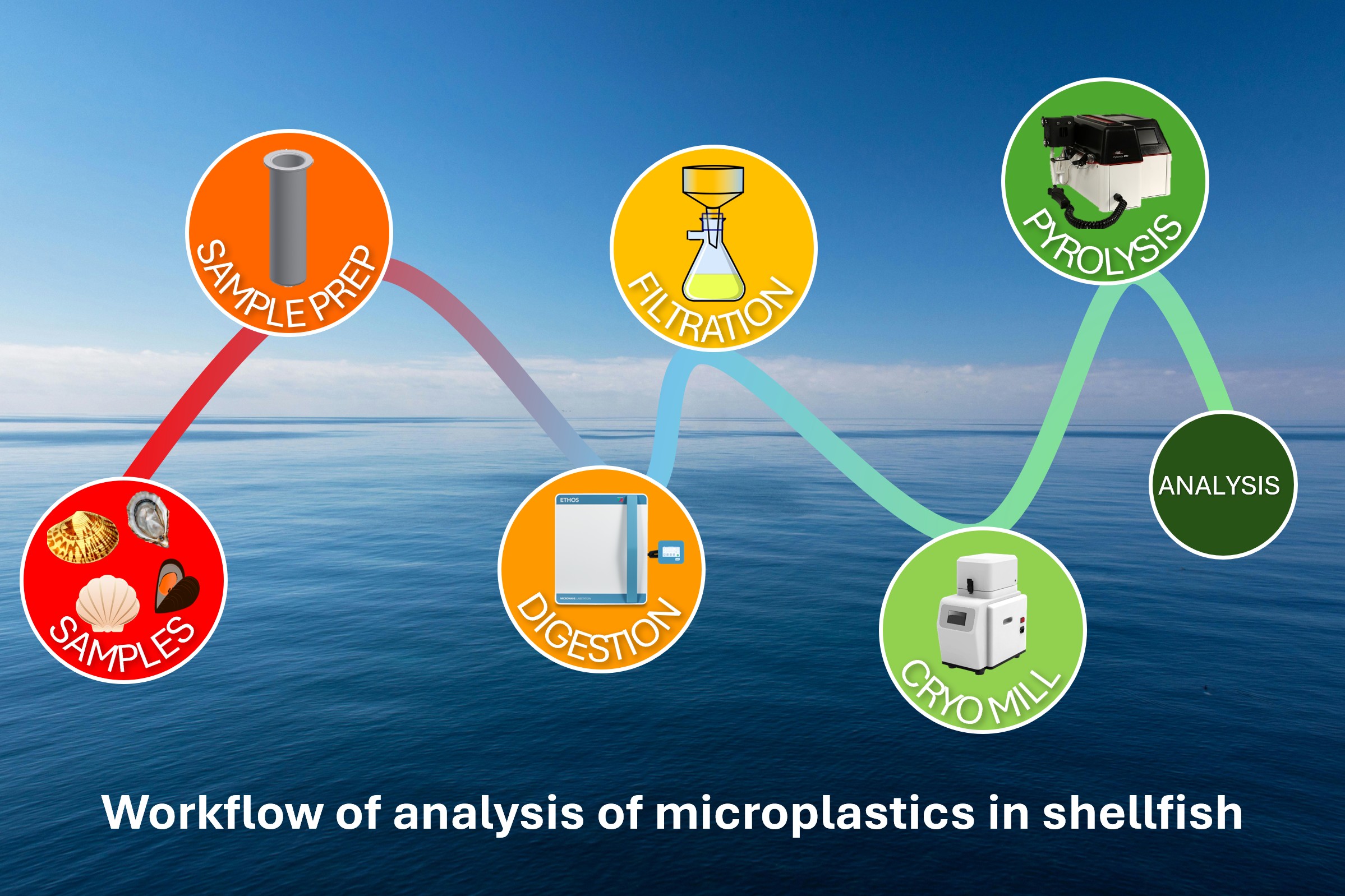
Many analytical techniques are capable of quantifying microplastics and those larger than 20µm can be analysed by FTIR and Raman spectroscopy on a count-based method.
It is impossible to analyse microplastics smaller than 20µm using these optical methods. Pyrolysis GCMS however can be used for these smaller sample sizes as it has no size limit and has the advantage that it can analyse multiple microplastics in a single analysis under 40 minutes.
A CDS application note describing the analysis of six microplastics using the CDS 6000 series pyrolyser is available from Analytix. Previous work employed alkaline digestion followed by cryo-milling and this established method has been further optimised with a CDS cryo-mill.
Four types of shellfish were analysed along with six microplastic standards using the new improved method. A linear calibration curve (R2>0.97) was produced using polymer masses between 4.4µg and 16.27µg with an RSD around or under 4% for just 4 runs. Additionally the spiked recovery of polystyrene was between 82 to 85%.
Quantification of the microplastics found that the shellfish contained polyethylene and polypropylene exceeding 80% of the total microplastic amount with ranges from 1µg/g to 15µg/g which is particularly important as it has been reported that polyethylene alone usually exceeds 80% of the total microplastic amount as described in the application note.
For further information or a copy of the application note call +44 (0) 191 519 4504 or click the link below.
For more information, click here.