
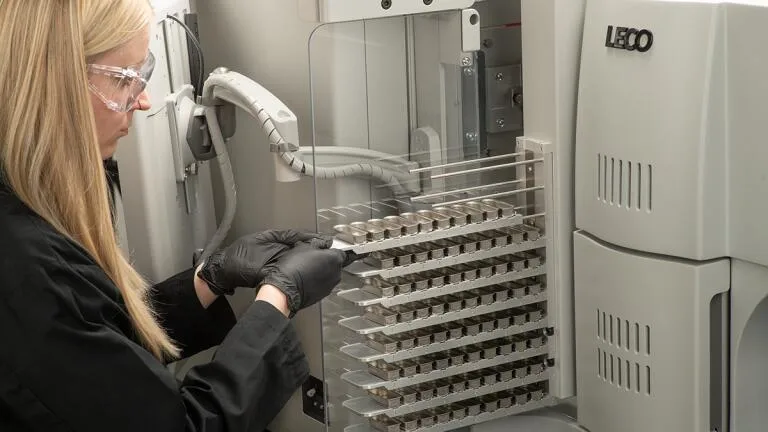
LECO has introduced its new 812 Series carbon and moisture determinator, combining faster thermal performance, improved detection limits and flexible multi-atmosphere operation to support carbon and moisture analysis across environmental, manufacturing and advanced materials applications.
The new 812 Series has been developed for rapid determination of carbon and moisture in a broad range of organic and inorganic materials. Alongside total carbon and total moisture measurement, the analyser uses thermal differentiation to separate and quantify individual phases according to their release temperature, providing laboratories with additional information about material composition and behaviour.
An updated horizontal furnace design incorporates improved active cooling and optimised temperature control. According to LECO, this can deliver ramp-up times up to 50% faster and cool-down times up to 30% faster, helping laboratories increase sample throughput. Carbon and moisture can also be determined simultaneously, reducing the need for separate analytical procedures and potentially eliminating labour-intensive chemical sample preparation.
Detector performance has also been enhanced, with the 812 Series offering up to tenfold lower carbon detection limits and twentyfold lower moisture detection limits compared with previous-generation systems. This extends the platform's suitability to applications requiring sensitive measurement at low concentrations.
Programmable furnace operation allows users to select oxygen or nitrogen atmospheres together with fixed or ramped heating profiles. The system is operated through LECO's Cornerstone® software, while front- and side-entry access has been designed to simplify routine operation and maintenance.
Applications include total organic carbon analysis in soils and waste materials, measurement of residual carbon contamination on cleaned metal surfaces and moisture determination in welding fluxes and consumables. The system can also analyse moisture in metal powders used in powder metallurgy and additive manufacturing, where moisture can contribute to oxidation, porosity and variability in finished components.
The 812 Series supports methods including ISO/EN 17505, EN 15936, ISO 10694 and AWS A4.4M.
