
From workshop to global presence: Kilian's 150 year journey
17 Dec 2025
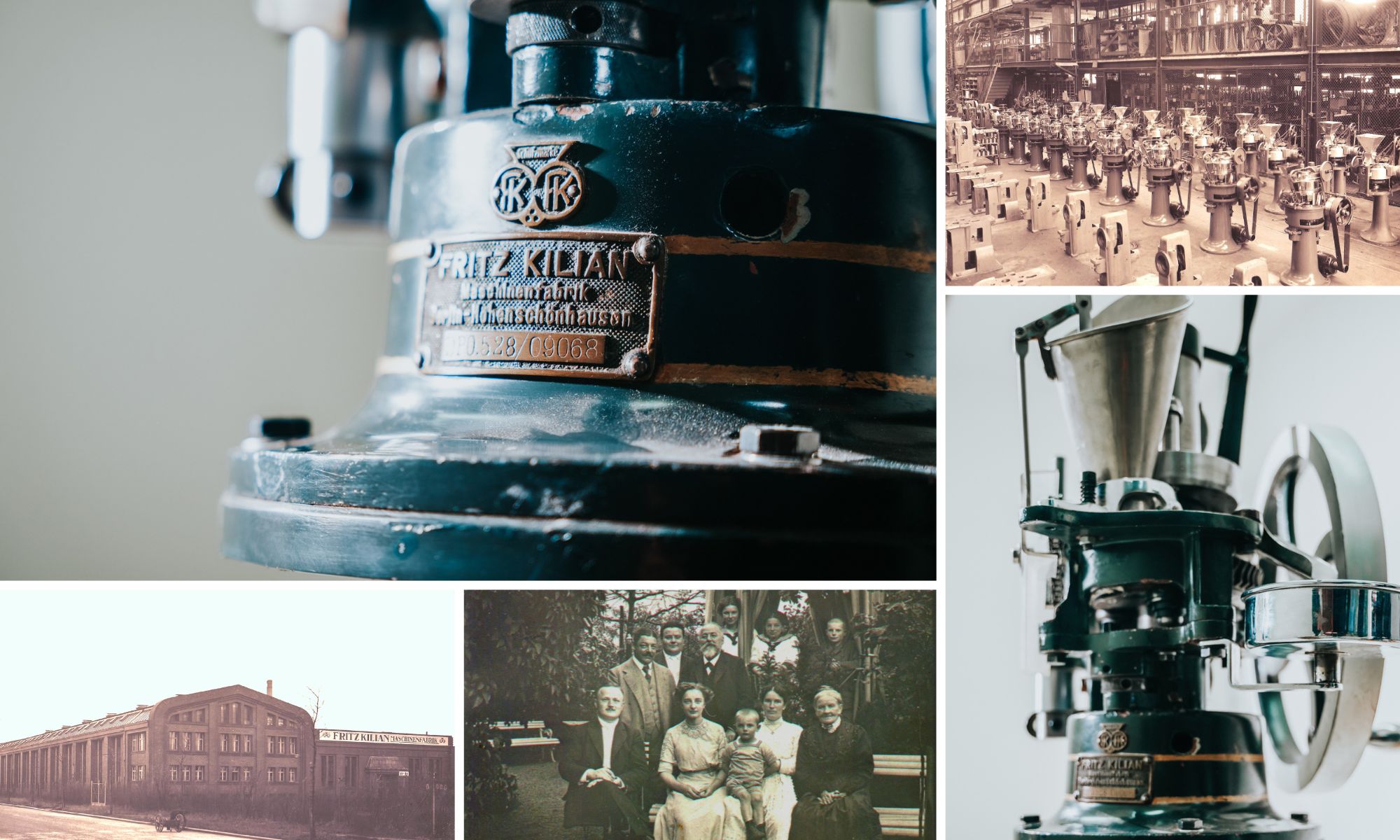
In the 19th century, locksmith-turned-engineer Fritz Kilian turned a Berlin family workshop into what remains a leading manufacturer of tablet presses: Romaco Kilian.
Some 150 years ago, in the Lichtenberg district of Berlin, Friedrich Franz Otto Kilian discovered his passion for engineering in the small locksmith’s workshop his father had founded.
Following an apprenticeship as a mechanic, the young man took the business following his father’s untimely death in 1886 and developed a keen interest in compression techniques.
His company was commissioned by pharmacies in the German capital to develop various compression devices, including a manual spindle press for producing pastilles, for which he obtained his first patent in 1891.
As his next major goal, he devoted himself to designing an automatic tablet press. His prototype impressed the German Imperial Military Administration, and this raised his order book to a whole new level. Fritz Kilian had now made a name for himself as an entrepreneur. He moved into new premises and named his company the “Fabrik pharmaceutischer Maschinen und Geräthschaften” (Factory of Pharmaceutical Machines and Apparatus). In 1898, he obtained a patent for his universal press – the eccentric tablet press 4D, in which printing of the finished tablets was also incorporated.
To cope with the rise in incoming orders, Kilian established new company premises including residential quarters in Berlin-Lichtenberg and, in 1899, began trading under the name “Fritz Kilian Maschinenfabrik” (Fritz Kilian Machine Factory). He chose a powder mill bearing his initials as the company logo, demonstrating his expertise in the handling of the raw materials involved in tablet production – knowledge that, even then, was critical for end product quality. His customer-focused, end-to-end approach and foresight as regards the importance of compressed products for various industries were key to his entrepreneurial success.
In 1905, a second factory was built in Berlin-Hohenschönhausen, significantly expanding production capacity. This laid the perfect groundwork for a modern company with a workforce of over 100 and numerous branches in other countries, including in the U.S. and UK. Kilian won the 1913 EXPO in Ghent, Belgium’s Grand Prix award for his automated machines for pharmaceutical products. In his career he acquired more than 60 patents until his retirement aged 74.
Fritz Kilian emerged unscathed from the Wall Street Crash in the late 1920s, in part because the pharmaceutical industry was less affected by the general downturn. With the onset of the Second World War Fritz Kilian stepped back from active involvement in the company and passed the business on to his two sons, Fritz Jr. and Hans. However, just one year later, Fritz Kilian Jr. was killed when the train he was travelling on was bombed. A year later, Fritz Kilian Sr. died of a stroke, aged 76.
He chose a powder mill bearing his initials as the company logo, demonstrating his expertise in the handling of the raw materials involved in tablet production
Under Hans Kilian the firm’s two production plants in Hohenschönhausen and Lichtenberg in Berlin survived the war virtually unscathed but in 1946, he was arrested by the Soviet military administration. Initially detained at the prison in Berlin-Hohenschönhausen, he was transported to the Special Camp Sachsenhausen near Oranienburg where he is thought to have died a year later of tuberculosis.
As operations at the Maschinenfabrik Fritz Kilian ceased head of production Werner Rühe and head of engineering Fritz Greter, fled to the Western Occupation Zone – with company documents and format drawings with them in their luggage.
In 1947, Fritz Kilian Jr. widow rebuilt the company with Rühe and Greter, securing a production partner, Strunk. In 1948 the newly founded Kilian & Co. GmbH was set up in Ehrenfeld, Cologne as the official representative of the Maschinenfabrik Fritz Kilian.
Demand for spare parts and services meant the company overcame its initial teething problems in its new setting and launched the first fully enclosed Kilian tablet press made in Cologne onto the market in 1952.
Fritz Jnr’s widow went on to marry wealthy English manufacturer James Frank Marshall . In 1953, the couple acquired a majority stake in Kilian & Co. GmbH, when, production was outsourced to the Schmidding-Werke plant in Cologne.
After Marshall’s death, Kilian was finally sold in its entirety to Schmidding-Werke in 1976 and remained a privately owned company until 2000, before Kilian & Co. GmbH was then sold to the Italian group IMA S.p.A. After 13 years it was sold to current owner Romaco.
Several of Fritz Kilian’s technical achievements were groundbreaking for modern tableting technology
Today, the successor models to Fritz Kilian’s original tablet press machines have joined the portfolio of Romaco, a one stop provider with technologies that cover the entire process chain for the manufacture and packaging of pharmaceuticals and non-pharmaceutical products.
Technical achievements
Today, Kilian is the oldest still active manufacturer of tableting technology in the market. Several of Fritz Kilian’s technical achievements were groundbreaking for modern tableting technology, and these deserve a closer look. In 1900, Kilian designed a pair of compression rollers for his rotary presses, so that the compression force could be generated by upper and lower punches. The practice, still common today, of pre-compressing products before they enter the main compression unit, was developed by Kilian. The company launched a press with three filling stations for multilayer tablets way back in 1908. The best-known rotary tableting system from the early Kilian years is probably the “Heinzelmännchen”, named after the mythical helpful elves of Cologne because of its user-friendly design. And in 1919, Kilian introduced the non-wearing upper punch guide.
In the mid-1930s, Kilian’s industrial production of tab-in-tab applications was another pioneering invention that grew in popularity after the war. At this time, tablets were increasingly becoming the method of choice for taking antibiotics. However, the core containing the active ingredients needed to be dry-coated to protect the unstable substances and mask the bitter taste of the medicine. Kilian had set the standard for the tab-in-tab production process, which helped the company gain a foothold in Cologne in the early 1950s and remain an active player in the international market until this day.
Pic: Clockwise from top left: Kilian nameplate bearing the stylized powder mill logo; assembly workshop; Fritz Kilian Sr. (first left, front row) with family in 1914; ‘Helpful Elf' 1918 tablet press; company headquarters 1922
